
Author’s Note on Language and Analogy
Before I begin, I want to be explicit about the use of psychological language in this text.
The clinical analogy that follows is not intended to stigmatize people living with mental illness, nor to trivialize the realities of psychiatric diagnoses. Psychological concepts are used here metaphorically, as an interpretive framework for understanding systemic behavior under chronic stress.
Mental illness is not a moral failure, nor is it a punchline.
If anything, this analogy is meant to highlight how urgently systems - like individuals - require care, responsibility, and stabilization when patterns of harm emerge.
N.B. a German version of this article was published in MusikTexte.
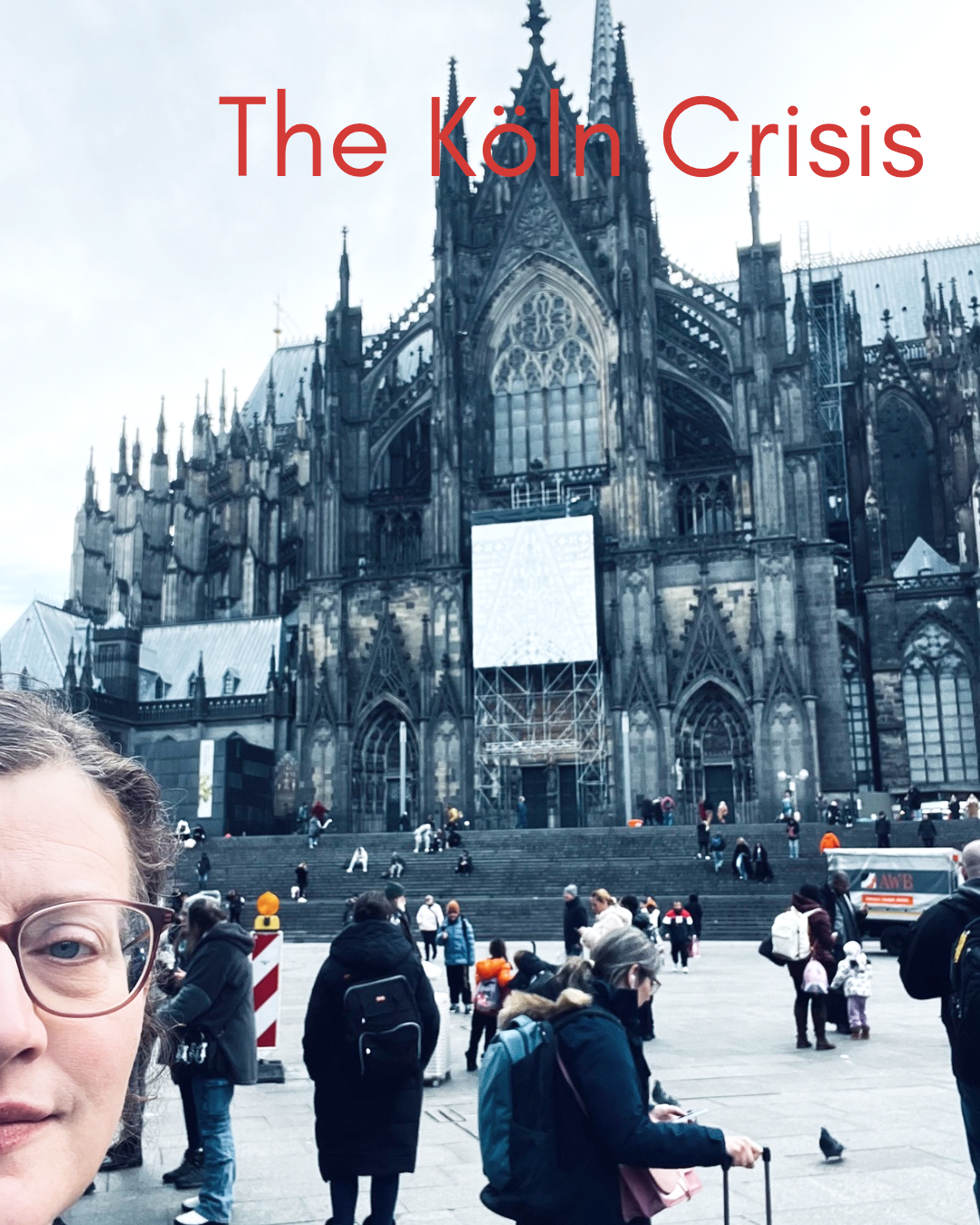
The Köln Crisis – A Psychological Intervention
How a once-great cultural city is fracturing into self-harm - and dragging its artists with it.
Five years ago, I opened TGR The Green Room - a small, stubborn center for artists in crisis.
In the beginning, the crises were circumstantial: the impacts of COVID, cancelled seasons, and a sudden withdrawal of societal relevance. By 2022, the emergencies were geopolitical: Ukrainian artists arriving disoriented and traumatized. Now, in 2025, the crises are local - created not by war or pandemic but by Cologne itself.
The Green Room now offers donation-based counseling to artists and cultural workers watching their life’s work slip. Again and again, you hear similar things: something fundamental in the city’s relationship to its artists has come undone.
Cologne is beginning to behave like a patient in psychological disintegration — caught in cycles of self-harm, broken attachments, identity diffusion, and impulsive decisions that damage the structures that once identified and sustained it.
If Cologne walked into my practice, I would be considering a diagnosis of Borderline Personality Disorder:
unstable self-image: proclaiming itself a “Kulturstadt” while dismantling the conditions culture requires
unstable relationships: weakening or abandoning long-term partnerships through inconsistency, silence, or abrupt withdrawals
self-harm: slashing budgets, freezing funds, starving the ecosystems that give the city its pulse
impulsivity: endless renovations, scandals that drain attention, restructurings without strategy, and financial decisions stripped of foresight
The ‘diagnosis’ is provocative, but the situation demands a vocabulary adequate to the damage being done.
Five Years in Cologne: Death by a Thousand Paper Cuts
I have lived and worked in Berlin, New York, Boston, and Paris - cities with their own quirks and dysfunctions, but also with a basic understanding that artists form an integral part of civic life. I have seen institutions fail, repair themselves, and even reinvent themselves under pressure.
But nowhere have I seen a city systematically work against the very people who sustain its cultural identity as consistently as Cologne. And this is not anecdotal frustration, but rather a pattern that artists across disciplines describe with exhausted precision.
Dancers, composers, theater-makers, cultural workers, freelance musicians - people with different aesthetics, politics, and working worlds - describe a similar landscape.
Support programs look substantial on paper but fall apart when approached in practice. Decisions drag on for months or years, and when they finally arrive, they bear no traceable logic. Priorities shift abruptly, leaving projects stranded mid-process. And beneath all of it lies an unmistakable tone: artists are left feeling ornamental, not integral; and are feeling welcome only when they demand nothing.
This climate wears people down. It drains initiative. It teaches artists to expect little and ask for even less. The result is only visible if you pay attention: a slow, steady movement away from Cologne, or away from its arts scenes … Resignation. It is the quiet exodus of people who no longer believe the city imagines a place for them.
A Culture System in Freefall
From a clinical perspective, Cologne’s cultural system is displaying the four classic behavioral stress responses:
Freeze
The Haushaltssperre (budget freeze) has left individuals and institutions suspended in uncertainty, unable to judge what can be planned or relied upon. Cultural workers describe a mental contraction I recognise from clinical work – a sense of future rigidifying because the ground will not hold still.
Flight is becoming the dominant adaptation. Cuts to the independent music scene, years-long delays, and unstable funding structures have pushed ensembles, festivals, and long-standing initiatives into retreat. Some relocate and others scale down. Some quietly dissolve. A cultural landscape rarely cracks all at once; it thins out as people and projects slip away, unnoticed.
Fight shows up in leadership crises. The opera renovation entering its fourteenth year; conflicts in major institutions; accusations of misuse of power; abrupt departures - these are symptoms of systems turning inward, defending territory, and directing energy toward infighting instead of development. Under pressure, organizations begin fighting their own members more than their challenges.
Fawn - the least acknowledged - is visible too. Artists and cultural workers describe adapting by becoming excessively compliant, lowering expectations, avoiding conflict, and accepting conditions that would be unacceptable elsewhere. The Fawn response is especially pronounced among newly arrived artists — those fleeing war, persecution, or political instability. Their vulnerability is too often exploited: underpaid work, or being used symbolically in programming without real support.
When a system offers no stable structures, people learn to please whoever holds the smallest amount of power or access.
Taken together, these responses wear the system down. Boundaries lose their clarity, responsibility drifts, communication fractures. In that atmosphere, people begin to pull back from their work, trim their aspirations, and eventually slip away.
Across disciplines, artists describe chronic uncertainty and a growing sense of being unheld by the same system that depends on their labor.
A cultural ecosystem can cope with scarcity to a point; what it cannot cope with is chronic instability and non-responsiveness. Cologne is nearing the tipping point.
Once a World-Leading Cultural City - Now a Cautionary Tale
Cologne was not always like this. Older generations of artists still speak of a period when the city had a clear pulse - when risk was possible, when networks and supports held. The 1970s and 80s generated impressive artistic lineages: radical experimentation, galleries that shaped international discourse, an electronic-music studio that drew composers from across the world, bookstores that functioned as gathering spaces, visual arts movements that defined a generation.
It was a city capable of creative metabolism - taking in, transforming, producing. That memory is important because it reveals the scale of what is now being lost. The system no longer holds together. Leadership turns over, institutions lose ground, and artists quietly remove themselves.
None of this happened overnight. It is the cumulative effect of years of avoidance, fragmented leadership, and the erosion of structures that once sustained an unusually dense artistic ecosystem. Cities do not lose their cultural identity suddenly. They lose it when the conditions that allowed art to thrive - support, dialogue, risk tolerance, shared purpose — quietly disappear.
What a Clinical Intervention Would Require
If Cologne were a client, the first step would be stabilization. Stop the cycles that inflict fresh harm: the budget freezes, the abrupt cuts, the constant uncertainty. Create conditions in which cultural workers can predict their environment for more than a single fiscal year.
The second step would be rebuilding relational trust. Systems heal when communication becomes reliable - when organizations receive responses, when decisions have clear rationale, when the city demonstrates that attachment to its cultural sector is not merely symbolic but lived.
Identity work would follow. Cologne must decide what cultural role it is actually committed to inhabiting. A self-concept has no power if it is not accompanied by behavior.
The fourth step: restore basic executive function. Fill critical roles, create competent service units, clarify responsibilities, and establish mechanisms that prevent crises from becoming the norm.
And finally, cultivate empathy - not as a weak and sentimental afterthought, but as a governing principle. Artists are workers carrying emotional, intellectual, and social labor; treating them as embellishment destabilizes the entire system.
The Choice Ahead
What Cologne faces now is not a financial problem alone. It is relational and psychological - a system harming the very people it depends on. This damage is reversible. Cities have recovered from worse when they chose clarity, responsibility, and care over drift. Artists are not asking for privilege, only for conditions that do not undermine them. The independent scene is resilient, but resilience has limits. Cologne must decide whether it is willing to repair what it has broken, or whether it will continue the patterns that have already driven many away.
Healing is possible, but only through committed action.