
a.k.a. a Pianist’s Room of her Own
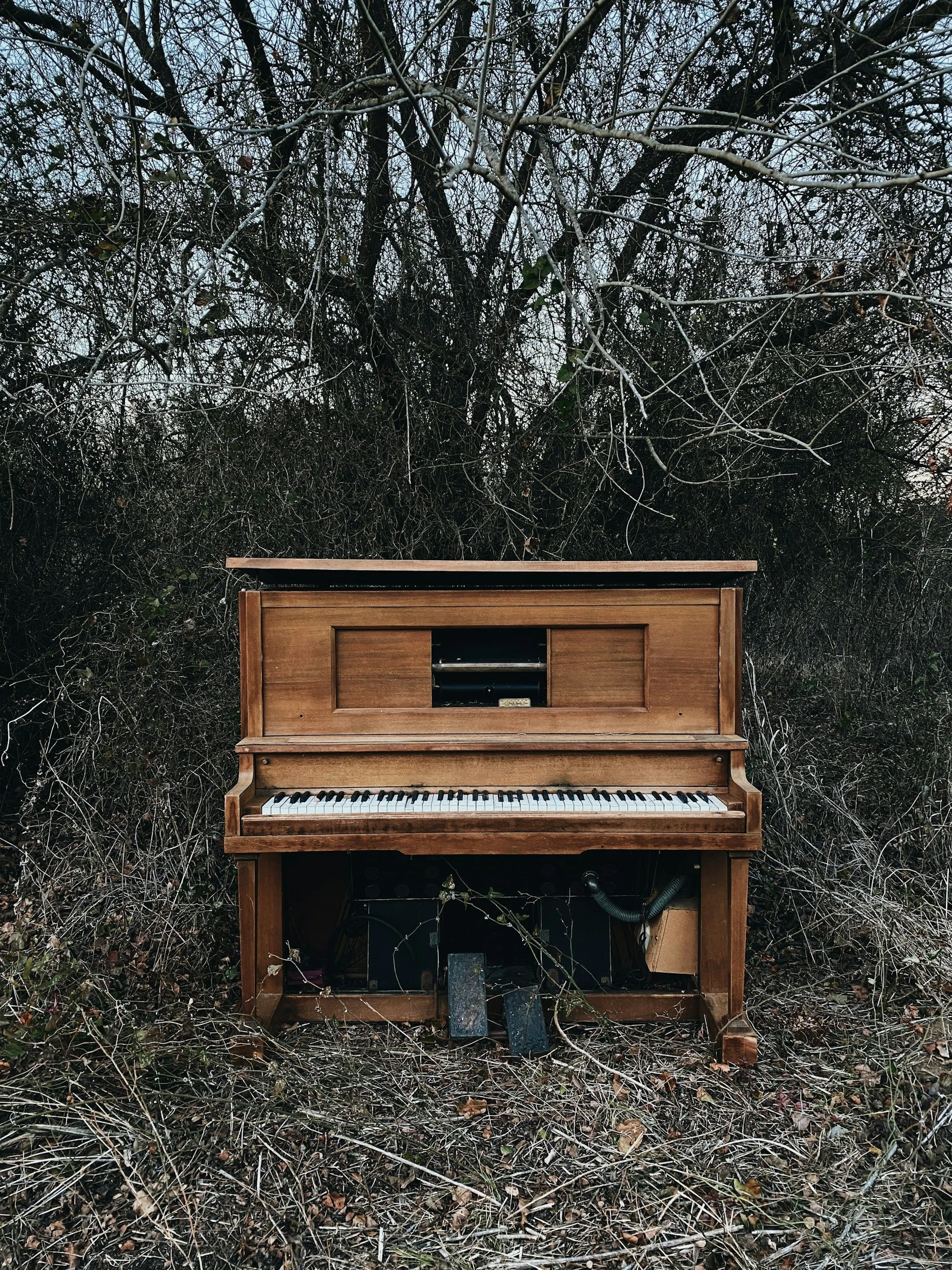
Recently, I needed to find a new home for my grand piano, ‘Charlotte’. I have a history with this process - one could say almost a traumatic history, as pianos (and pianists) are among the most despised neighbors possible, even more so than lepers or punk rockers.
Now that I’m a psychologist and not a professional musician, I thought it would be savvy to come into conversation with the future neighbors three full months before the move. On a sunny June day, I approached an elderly gentleman, sitting in the garden in the late-afternoon sun, and told him of my intentions to move the piano to an atelier in the house adjacent to his. Fear sprang into his eyes. He nervously excused himself, stating that he had to talk with his wife. Several seconds later, Oma burst out, red-faced and propulsive, wielding a cooking ladle in her hand, vigorous despite her 70-something years, demanding to know what this was all about.
I gave ‘the speech’: “I’ll practice at most one hour a day, mostly very calming music, we can exchange numbers, and if there’s a problem, I’ll just adjust the time of practice whenever necessary.”
The speech did not calm her rattled nerves. She stated that it was a known fact that all pianists live out in the countryside, perhaps in barns, and that there are no pianists living within city boundaries because this would bring about the End of Civilization (I’m paraphrasing). Despite the fact that I know that cities hold countless numbers of pianists - thousands, tens of thousands, perhaps billions – and that there is no such thing as a ‘piano barn’, I tried to calm her nerves by repeating, slower and with more enunciation, my ‘speech’.
We left with sore feelings on both sides and no concrete resolution. Six weeks later, the management company rejected my written form of ‘the speech’, stating that my presence in the building would be too disruptive. Though this is probably illegal, I dropped it and complained vigorously to anyone who would listen and began the slow process of licking my wounds. I also roamed the neighborhood looking for a new home, miraculously - really miraculously - finding one in a former ballet studio one minute walking distance from home.
This experience brought up a lot of dirt. It’s not easy to play a nineteenth-century instrument in a twenty-first-century world. Pianos can bring an entire apartment house into resonance. The sound runs down the legs of the instrument, into the floorboards, and the entire housing structure vibrates to chords, scales, arpeggios, manic repetitions, and frustrated poundings. Because every tone can be heard from the basement to the 32nd floor, most pianists I know have become neurotic. Either they are meek and mouse-like, perfecting their pianissimos at home, and finding an expensive practice room in which they can rage. Other pianists stand defiant and insist on the housing laws of most German cities that enable people to use their home spaces for music-making within reasonable timeframes. I actually don’t know too many pianists from the second category. Most have become submissive and beaten down. Or else they live off the land and develop their own wild piano barn.
This story has a happy ending for me. In the former ballet studio, I can use my sixty minutes per day to delightful advantage. I love my hour there each day, not only for the acoustics and comforting atmosphere. I love it mostly because I know that not one single human on earth can hear me there, and that completely changes the way I can work. It frees me to explore, to sound shitty, to improvise in a way that sounds sentimental pop songs from the 1970s, and to even sometimes sing along, sometimes cracking myself up, cackling like a witch. If this would be observed by anyone, I’d be sent away - not to a piano barn, but to a funny farm. Note to any judgemental pianists reading- yes, sometimes I actually practice there.
This experience makes me wish that all pianists - no, all musicians - could have spaces and contexts that make it conducive to do their work. It’s not an extravagant wish, just a wish for a kind of simple space that supports rather than erodes.
If I put on my systemic-therapist glasses for a moment, the whole episode comes into focus.
Systemic therapy, in its essence, says:
“Maybe I’m not actually depressed. Maybe I’m just surrounded by assholes.”
This is not because people are villains, but rather because distress is almost always interactional and not simply internal. Systems make symptoms.
Germany is known as the cradle of “serious music.” Bach, Beethoven, Schumann, Brahms - name them like saints in a litany that shaped the German self-image. No country has more streets named after composers. No country wraps its cultural legitimacy so tightly around music written by dead German men.
And yet: put a living musician in an apartment, and suddenly the entire building has a panic attack.
It is as though the society reveres the symbol of the musician but shuns the practice of musicianship. The cultural figure is canonized; the actual living process is treated as a contamination risk. Germany loves chamber music concerts, Bach cantatas, the mystique of the Steinway, but the physical act of practicing Bach as one’s daily labor is treated like a public health crisis.
From a systemic perspective, this is a deep incoherence: a culture with a split identity.
On Sunday at the Philharmonie, musicians are heroes.
On Monday, they are noise and bothers.
This tension goes beyond irritating musicians - it shapes them, running deep into their muscle fibers and impacting their cellular health. It infiltrates the nervous system. It trains vigilance and teaches self-minimization and erasure. It encourages the basic systemic position that musicians are permitted only in ritualized contexts like concert halls, but not really in the chaotic and sometimes loud texture of daily life. In everyday city life, jackhammers are tolerable. Pianists are not.
And because we internalize systems faster than we question them, we begin to believe it ourselves.
The neighbor with the ladle, the building manager, the pianist - we are animated by the same contradictory cultural inheritance. We are trying to preserve the aura of the Musician while banishing anything that sounds like the messy workshop from which Musicians emerge.
From the outside, this manifests as “neurotic musicians,” but perhaps it is not neurosis at all, perhaps it is social accommodation to systemic incoherence, including precarious working conditions, chronic self-censorship, and the need to apologize for existing.
Systemic therapy has a term for this: symptom as solution.
The “symptom” (hyper-vigilance, apologetic behavior, self-effacement) is not viewed as a personality flaw but rather as the organism’s best attempt to survive inside a contradictory system.
If Germany actually believed in its musical tradition, it would make space for its living forms. Instead, it worships the marble bust and fears the studio. This problem is, of course, not unique to Germany. Most populous places on earth are not accommodating for musicians.
This is why the ballet studio is much more than an empty space… it is a counter-system. It allows the act of music-making to exist without triggering the contradiction. It provides cultural legitimacy, not through institutional reverence or funding structures but through something far simpler and more embodied: walls that do not transmit shame.
Soundproofing, in this sense, has nothing to do with a mechanical and material process. It is psychological containment. This is not isolation, but rather the conditions under which a nervous system, my nervous system, can unclench.
And this returns us to systemic thinking: conducive environments are crucial because they subtly dictate which versions of ourselves are possible. The historical-cultural system dictates that musicians must be both sacred and invisible. The architectural-acoustical system dictates that musicians must be apologetic. The interpersonal system dictates that musicians must brace themselves against disturbing others.
The ballet studio disrupted all three. It represents a small systemic resettling of my artistic ecology.
In the mythology of music, the room of one’s own is imagined as a cabin in the woods, a perfectly silent monastery. But I don’t want silence. I jst want decent systems. A context that does not force me - and, by extension, every musician in every apartment in every city - to be alive only in rehearsed, socially sanctioned fragments.
Germany venerates Beethoven’s deafness, but cannot tolerate a pianist producing audible sound. Systemic therapy encourages us to hold that absurdity gently, not as a rigid accusation, but as mere information: this is a culture that loves its idea of music but is currently not building the actual habitats for music-making.
And so the question need not be: “How do musicians cope?” but rather “Where does the system need to shift so musicians don’t have to perpetually contort themselves to fit it?”
Rooms speak. Walls transmit. Culture abides. Systems support or erode.
And the body - mine, yours, all musicians, even the dead ones - responds brutally honestly to the context it is given.