

Shame as a Power-Tool
An email lands in a musician’s inbox.
It is written in the voice of authority - measured, paternalistically disappointed, with a dash of avuncular scorn. Nothing overtly aggressive. No SHOUTING, no insults, nothing easily identifiable as abuse. Precisely restrained enough to remain defensible. Perhaps he intended it as a joke. And yet something happens in the body while reading it: a clench in the stomach, a tightening in the chest, the unmistakable sensation of having been scornfully exposed, washed in shame.
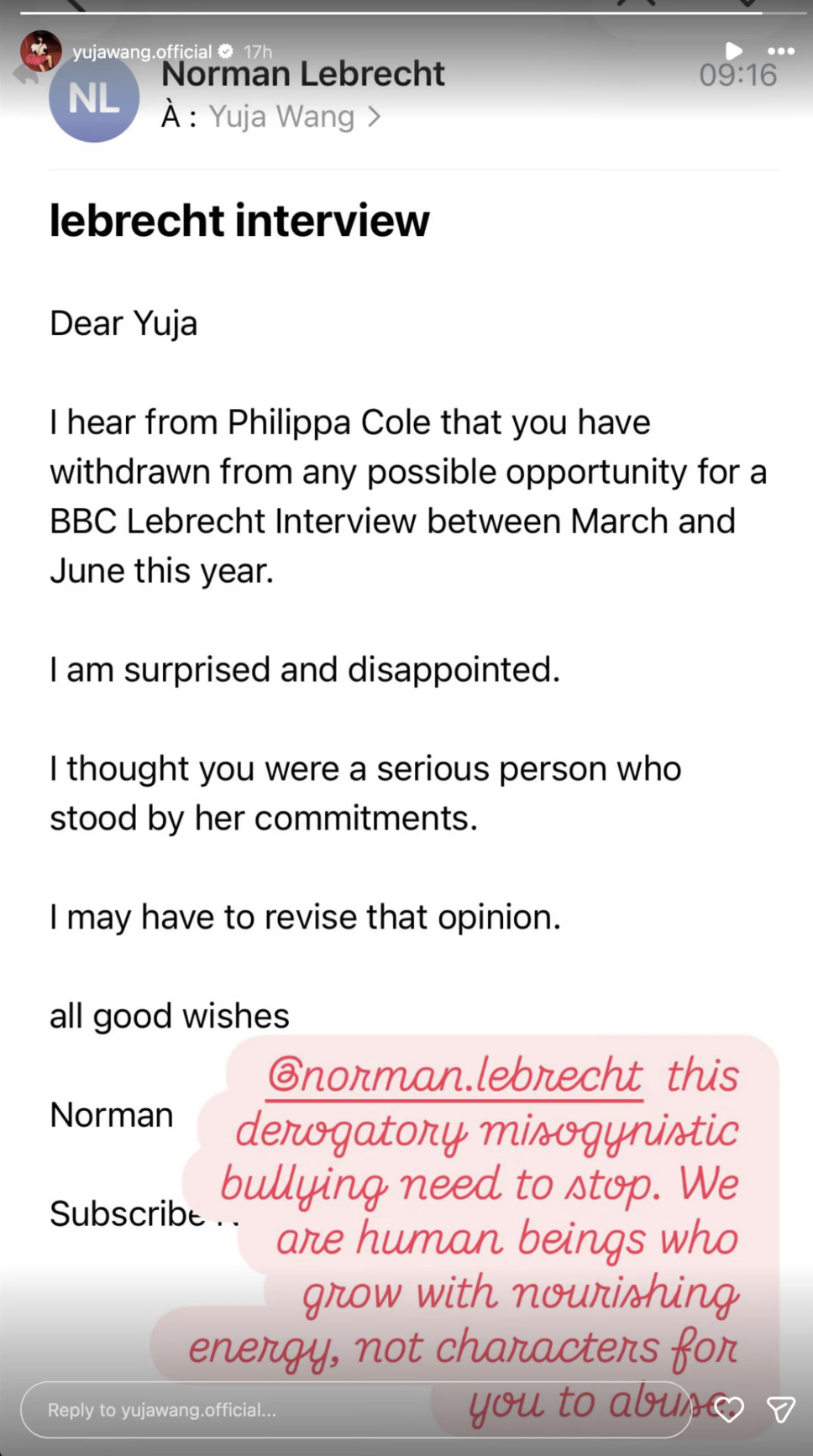
A few days ago, pianist Yuja Wang made public an email she received from critic and former BBC Radio 3 presenter Norman Lebrecht after withdrawing from a planned interview. His message framed her cancellation not as a logistical change or personal boundary, but as moral disappointment: I thought you were a serious person who stood by her commitments. I may have to revise that opinion. Wang responded by naming what many musicians recognize immediately beneath the polite phrasing - derogatory misogynistic bullying.
The exchange was brief, the sort of interaction that might normally pass unnoticed in an industry accustomed to hierarchy and strong personalities. Yet its clarity is revealing. It shows how shame operates within music culture not merely as emotion, but as regulation.
Shame as a Personal Burden
We tend to imagine shame as a personal issue - an inner sensitivity to be managed through the development of confidence or resilience. Within artistic institutions, however, shame functions socially. It organizes behavior behind the scenes, enforces norms without naming rules, and allows power to remain largely invisible because compliance appears voluntary. Authority rarely needs to assert itself; it speaks through the language of professionalism and excellence. The moral tone does the work.
Psychological discourse has often reinforced an individual framing, treating shame as an individual vulnerability or pathology and locating solutions in personal repair: thicker skin, stronger self-esteem, better regulation. Such approaches may help individuals, but they obscure a more uncomfortable possibility — that shame is not only experienced by people but produced by cultures.
Systemic perspectives shift attention from supposedly shame-prone individuals toward the relational contexts in which shame repeatedly emerges. The question becomes less why someone reacts strongly and more how certain encounters reliably position people as inadequate or conditionally acceptable. Shame, in this sense, is not simply a trait but an arrangement.
Belonging and Its Conditions
Music cultures provide fertile ground for such arrangements. The field is structured around evaluation and scarcity. Access to work depends on reputation, recommendation, and belonging within networks that are intimate yet opaque. Careers advance through informal judgments as much as formal criteria, and the boundary between inclusion and exclusion often remains unspoken. Under these conditions, shame becomes efficient, recruiting artists into self-regulation long before explicit enforcement is required.
And Belonging is not a luxury for musicians. It determines access to stages, teachers, contracts, collaborations - the conditions that allow artistic life to continue. When belonging feels fragile, shame becomes pervasive. The threat of not belonging is rarely realized by punishment itself but by social disappearance: cooled enthusiasm, fewer invitations, the subtle sense of having become “difficult.”
The Lebrecht email performs this mechanism cleanly. A professional boundary becomes a character flaw. Disappointment becomes moral evaluation. Authority is implied. The recipient is positioned not as a colleague making a decision, but as someone whose seriousness is under review.
Learning Silence
I recognize this tone from my own years as a professional musician. The moments were almost always too small to protest: a remark after a concert, an ambiguously phrased email, criticism easily defended as constructive. Individually viewed, such things were trivial, but collectively they felt damaging and destabilizing. When recalled later, they still sound to me to be embarrassingly petty. Yet, despite my cognitive evaluations, my body registers them unmistakably as a threat. That imbalance is where shame derives its power. It persuades the recipient that objection would itself be disproportionate. Silence begins to feel like professionalism - even maturity.
Shame works because it threatens not morality but membership. Despite being called a moral emotion, it is fundamentally relational, emerging when acceptance feels conditional. Music culture is saturated with subtle reminders of this conditionality: be grateful, be easy, don’t cause trouble, don’t embarrass yourself, don’t speak too openly about what happens behind closed doors. Enforcement rarely appears as punishment; it takes reputational form, allowing coercion to remain largely invisible.
The ability to resist such dynamics is unevenly distributed. A globally renowned artist may challenge a critic publicly with limited risk. A student on scholarship, a freelancer dependent on recommendations, or an artist navigating precarious immigration status often cannot. Systems sustained by shame require not universal silence, only the silence of those with the least protection.
Learning Shame
This dynamic becomes especially visible in pedagogy. Conservatory culture carries a mythology of rigor, and rigor is indispensable to artistic growth. But humiliation and rigor are not synonymous. In many training environments, shame is reframed as excellence: public correction as character-building, emotional suppression as professionalism. Musicians may emerge technically formidable yet increasingly disconnected from their own interior signals in order to survive evaluation.
When shame later appears clinically - as anxiety, impostor feelings, chronic self-doubt - the problem is easily located within the individual. Institutions remain intact while artists interpret structural strain as a personal inadequacy. Private suffering and sanctioned humiliation become the implicit cost of belonging.
“La honte doit changer de camp”
The opposite of shame is not shamelessness but dignity - a sense of worth not contingent on gate-keeper’s approval. Sometimes dignity emerges when shame changes sides. Gisèle Pelicot, who insisted on a public trial after discovering that her husband had drugged her and allowed dozens of men to sexually assault her, spoke about refusing to carry the shame imposed upon her, stating: “La honte doit changer de camp” [Shame must change sides]. By stepping into visibility, she altered its direction: shame no longer adhered to the victim but returned to those who produced the harm. The psychological mechanism is recognizable far beyond that extreme context. When shame changes sides, what once felt like personal failure begins to appear contextual or even structural.
Seen in this light, Yuja Wang’s response was less a celebrity dispute than a small interruption in an emotional economy many artists recognize. Naming tone as bullying disrupted the assumption that authority’s disappointment must be fully accepted.
Most artists cannot do this publicly. Change more often begins in smaller ways: a colleague acknowledging discomfort to a (passive/micro) aggressive comment, a teacher reconsidering humiliation as a form of pedagogy, an email written without apology for having boundaries, a decision to stop confusing agreeableness with integrity.
Hierarchical systems will always have access to shame as a regulating force. The more urgent question is whether artists continue paying for belonging with their interior lives - or whether we begin creating rooms, literal and metaphorical, in which participation no longer requires becoming shame-saturated and shame-shrunken.

Gisèle Pelicot