
When the Instrument Fits
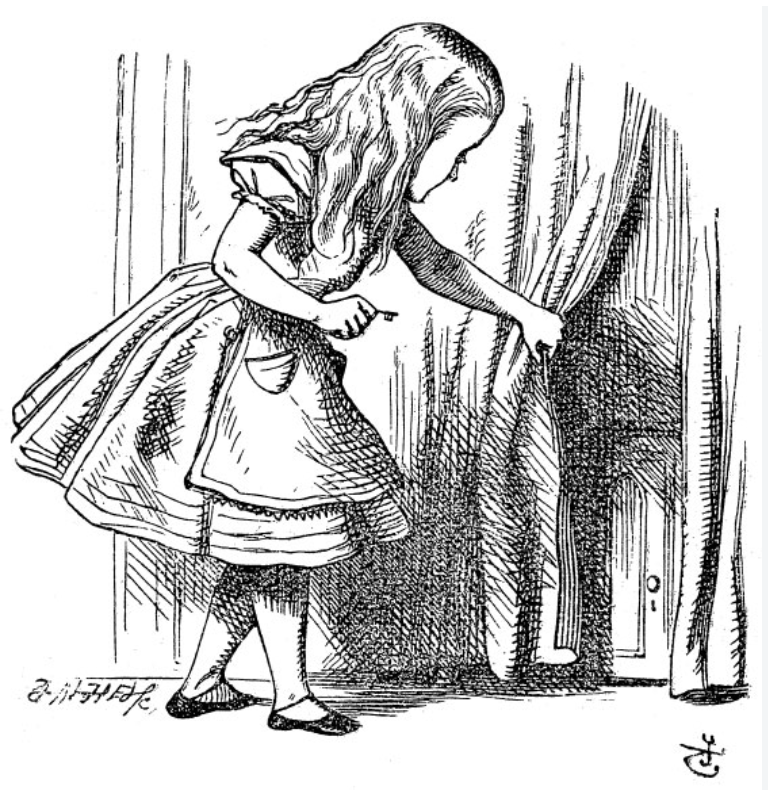
“What a curious feeling!’ said Alice….and her face brightened up at the thought that she was now the right size for going through the little door into that lovely garden.”
Alice’s Adventures in Wonderland, Lewis Carroll
At fifty-three years old, after nearly half a century of playing the piano, I had the curious experience of sitting down at an instrument that fit my body.
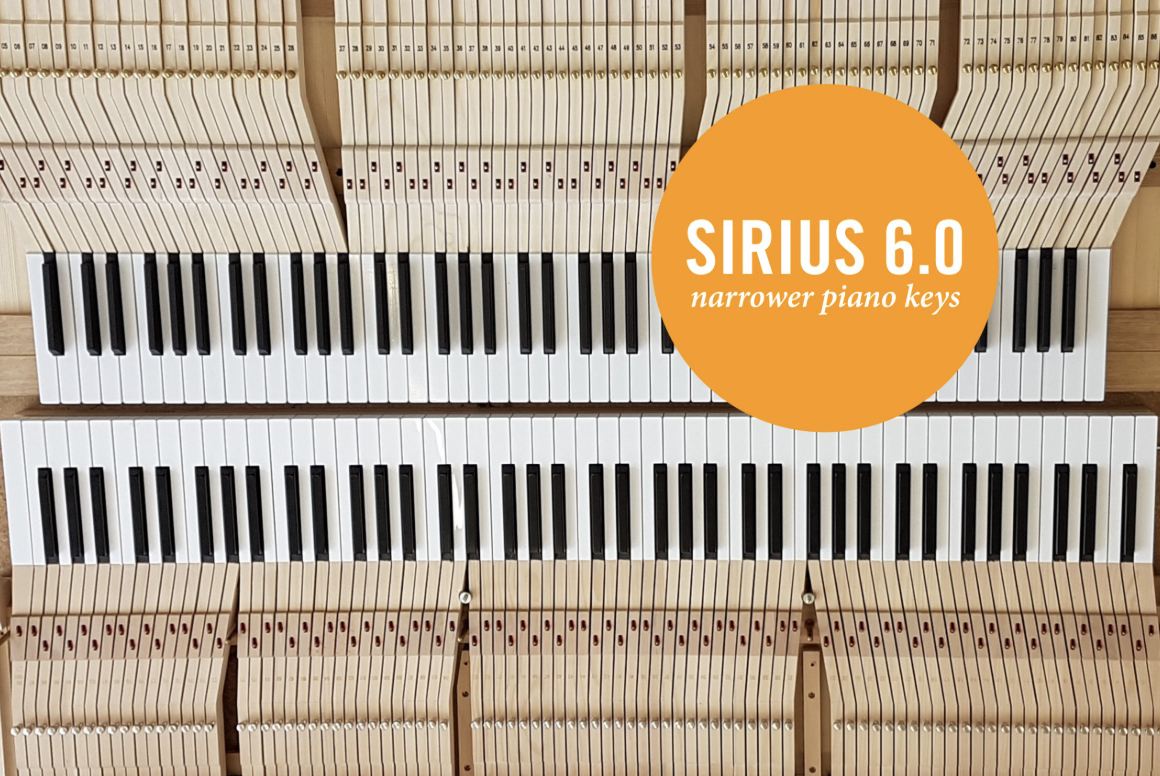
I was at the University of Music and Performing Arts Stuttgart, working on one of the SIRIUS 6.0 instruments that Ulrike Wohlwender and Silvia Molan have been developing and researching there. I had gone to Stuttgart partly in preparation for a performance at Hannah Reimann’s International Stretto Piano Festival in New York. Reimann, Wohlwender and Molan have spent decades advocating for narrower-key pianos, working with manufacturers, producing concerts, and creating opportunities for pianists to experience alternatives to the conventional 6.5-inch octave. Long before “stretto” pianos had much public visibility, they have been working tirelessly so that pianists have a choice.
The concept of the SIRIUS 6.0 is slightly magical - piano keys that grow your hands - although the mechanism is wonderfully simple: the hands do not grow; the keys get narrower.
Not much narrower, either.
On the conventional modern piano, an octave measures approximately 6.5 inches. On the SIRIUS 6.0, it measures 6 inches. That means that an entire octave is narrower by about half an inch , effectively giving the hand approximately half a key of additional reach across an octave. It does not sound like much.
It felt enormous.
In the six hours over two days with the instrument, my reactions were strongly emotional. I felt ecstatic, sad and angry in approximately equal measures. Ecstatic because playing was significantly less of a struggle. Sad because I had no idea this was possible. And angry because I had spent most of my life assuming that when my body struggled with the instrument, the problem to be solved was my body.
The adjustment itself took minutes. There was a brief period of perceptual strangeness - the familiar geography of the keyboard compressed slightly beneath my hands - and then a stronger impulse took over: ease. The instrument felt unfamiliar and strangely familiar at the same time, as if I were meeting a version of the piano I had somehow expected all along. There was also something historically appropriate about the unfamiliarity. Much of the repertoire on which I grew up was composed before the dimensions of the modern keyboard had become fully standardized. Historical instruments varied considerably, and during the late eighteenth and early nineteenth centuries their octave spans were often somewhat narrower than today’s 6.5-inch standard. Naotaka Sakai’s measurements of historical instruments suggest average spans approximately ⅛ to ¼ inch narrower than those of modern pianos;[2]
This rapid adaptation is not unique to me. Wohlwender and Molan told me that pianists trying the SIRIUS 6.0 are often surprised by how quickly their brains adapt to it. Players have described freer movement, less effort, greater precision and more subtle control of chord balance. Their point is therefore not simply that narrower keyboards make impossible stretches possible for very small hands. The change may alter the quality and economy of movement even for pianists who can technically reach the notes already.[3]
That distinction—between can reach and can move freely—seems crucial.
Pianists have a rather crude language for hand size. Can you reach an octave? A ninth? A tenth? The implication is binary: either the interval is available or it is not. But playing is not simply a question of whether the fingertips can make contact with the required keys. The hand has to move into and out of those positions, sometimes at great speed, repeatedly, while controlling timing, voicing, articulation, color and force. A hand that can just reach an octave and a hand that can lie comfortably over one are performing very different physical tasks.
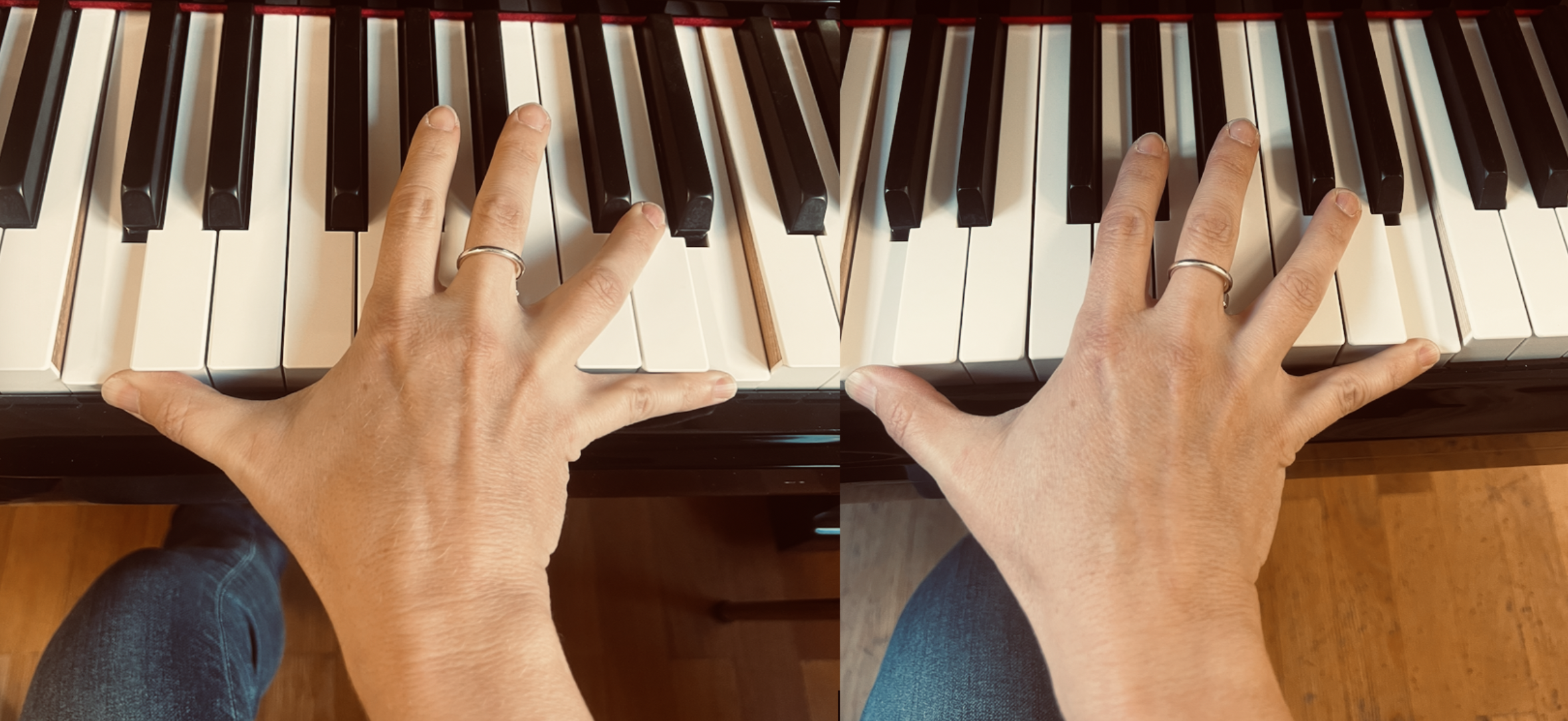
left: standard keyboard, right: SIRIUS 6.0
Research has increasingly begun to make that distinction measurable. Small-handed pianists show greater finger abduction and altered wrist and finger movement when playing octaves and chords on conventional keyboards. Ju-Yang Chi and colleagues, studying pianists on 5.5-, 6.0- and 6.5-inch octave keyboards, found that keyboard size changed muscular activity and that the effect depended on the pianist’s hand span; their results suggested that smaller-handed pianists may reduce muscular exertion on reduced-width keyboards.[4]
And, strikingly, a study published in Applied Ergonomics in 2026 now gives more direct evidence for the 6.0-inch size I was playing. Craig Turner and colleagues found that smaller-handed expert pianists showed 11.2–13.8% greater finger and wrist extensor activation than larger-handed pianists on the conventional keyboard. When the smaller-handed pianists played on a 6.0-inch octave keyboard, extensor activation fell by approximately 2.5–3.2%, and their fifth-finger posture became less abducted and more flexed. The authors are appropriately cautious about translating this directly into injury prevention, but the biomechanical direction is clear: changing the keyboard changed what the body had to do.[5]
The research is not abstract for me. For years I have had intermittent - and sometimes not very intermittent - pain in my hands and arms. Recently there has been a particularly persistent pain around the second finger of my left hand. It is there so reliably that I have largely stopped expecting its absence. After playing the narrower keyboard in Stuttgart, I noticed that it was gone. I do not know exactly what that means.
This was not an experiment. There was no control condition, no baseline measurement, no blinded assessor, and I am a sample of one with an extensive and complicated physical history. The pain may return immediately when I return to the conventional keyboard. It may return for reasons entirely unrelated to keyboard width. Bodies are rarely simple enough to offer clean causal explanations. The absence could have to do with the instrument simply fitting my body better mechanically, or the unfamiliar movement and sensory input may have shaken up the neural processing of chronic pain patterns, so that the usual pain signal was not generated in the same way. From two days of playing, I cannot know.
Still, absence has information in it. After years of asking what was wrong with my hand, I found myself entertaining a very different question: what if at least part of the problem was that the instrument did not fit it?
That sounds almost too simple. In most other areas of physical life, we regard fit as obvious. We do not insist that everybody wear the same shoe size and then send the people with blisters to physiotherapy. A violin comes in fractional sizes for children. Cellos do too. Office chairs are adjustable. Athletes select equipment according to size, biomechanics and function. The piano remains remarkably resistant to this idea.
Pianists are particularly accustomed to adapting because we almost never take our instruments with us. The violinist brings her violin; the oboist brings his oboe. Pianists arrive at an unfamiliar hall and meet whatever nine-foot beast happens to be standing there. We adapt to key resistance, action, repetition speed, voicing, pedal depth, acoustics and tuning. Lipke-Perry, Dutto and Levy describe the piano itself as a task constraint: performance emerges from the interaction between the player, the task and the properties of the instrument.[6] Their study found remarkably stable timing patterns as pianists adapted across different keyboards, illustrating just how practiced pianists become at accommodating changing instrumental conditions.
Adaptability is one of our skills, but it can also conceal mismatch, and adaptation itself may have a cost. If a pianist succeeds despite excessive stretch, rotation, tension or compensatory movement, the success itself can hide the physical cost. We see the notes being played and conclude that the instrument is playable. The musician may conclude the same thing. Perhaps this is one reason smaller hands have so often been treated as a technical problem to be overcome rather than as part of a design problem worth examining.
Whose body is the piano for?
Hand-span data makes this difficult to dismiss as an unusual problem affecting a small number of pianists. In a study of 473 adult pianists, Boyle, Boyle and Booker found a substantial gender difference in hand span: the average thumb-to-fifth-finger span among the women in their sample was about one inch smaller than among the men. Using their criteria for hand sizes that create ergonomic disadvantage on a conventional keyboard, they estimated that a very large proportion of female pianists—and a meaningful minority of men—fell into the smaller-hand category.[1]
The Stuttgart SIRIUS study refers to the hand research of the music physiology pioneer Christoph Wagner, who reports a similar basic disparity[2]: average span measurements for women are around 2.1 centimeters smaller than for men. Children, of course, begin with still smaller hands.[3] This does not mean that every smaller-handed player is unable to work with a conventional keyboard. It does mean that the same supposedly neutral dimensions demand proportionally greater stretch from many women, some men, and all children.
This led to one of the uncomfortable thoughts I had in Stuttgart: Is this what playing the piano feels like to a lot of men? I had suddenly gained access to an experience of the octave that I imagine is completely ordinary for a pianist whose hand is comfortably proportioned to the conventional keyboard.
The word that kept coming back to me was space: space between the fingers and inside chords, space to release one part of the hand while another was working, and space to think about sound rather than reach. The instrument seemed to require less negotiation. It fought back less, and it didn’t bite.
This matters artistically as well as medically. If part of the performer’s attention is continuously devoted to managing the mechanics of span, there is simply less freedom available for other things. Wohlwender and Molan’s reports are interesting in this respect because pianists do not describe only greater comfort; they describe subtler balancing of chords and greater freedom to focus on sound and expression.[4]
The argument for alternative keyboards is therefore not only about reducing strain. It is also an artistic question: what might pianists hear, imagine, or play differently if less of their attention were being spent negotiating the spatial dimensions of the instrument?
I would like a word with the nineteenth century
My emotional response to all of this included a rather unreasonable desire to travel back in time to the late nineteenth century. I do not particularly want to put the piano manufacturers on trial, but I would very much like a word with them about how this particular dimension became the dimension.
Keyboard widths were not always uniform. Earlier instruments varied considerably, and many had narrower spans than the contemporary 6.5-inch octave. The modern width became standardized during the later nineteenth century, in the same broad period in which the piano itself was becoming larger, louder, mechanically stronger and increasingly capable of filling large concert halls. Mass production and the needs of touring pianists also created obvious advantages to standardization.
There are accounts that connect the resulting size with the large-handed male virtuosi who dominated public concert culture at the time. Boyle and colleagues make this argument explicitly.[5] Other historical accounts are more cautious, and I think that uncertainty is worth preserving: larger instruments, changing actions, concert-hall acoustics, industrial standardization, and the requirements of travelling virtuosi all developed together.
We do not need to imagine a nefarious cabal of nineteenth-century men deliberately deciding to exclude women and children in order to end up with a design that disadvantages them. Systems rarely work so neatly; more often, somebody simply becomes the assumed user. In this case, the assumed body seems to have been very close to the body of the professional male pianist who occupied the prestigious end of nineteenth-century concert culture. Manufacturers optimized an instrument around the aesthetic and practical priorities of their time, and one particular physical specification gradually became invisible by becoming standard.
Once a specification becomes standard, we stop experiencing it as a choice and begin to treat the bodies that do not fit it as the changeable variable. This reversal is psychologically fascinating. Rather than saying, This keyboard is large for my hand, the pianist says, My hands are too small. Rather than saying, This passage requires an extreme span on this particular instrument, we say, I can’t reach it. The design recedes from view, and the deficiency migrates into the person.
Power, Volume, and the Values Hidden in Design
I also found myself thinking about aesthetics. The nineteenth-century piano developed alongside an appetite for greater projection and power. Larger halls, stronger frames, increased string tension, and changing actions supported a kind of pianistic scale unimaginable on many earlier instruments. The modern concert grand is one of the magnificent results, and I love that sound. But I also wonder what values became embedded in the instrument along with it: power, projection, solidity, massivity, the capacity to produce vast orchestral sonorities.
These are not intrinsically bad values. Beethoven stripped of power would be pallid; Rachmaninoff does not always want to gently whisper in your ear. But an instrument developed partly within an aesthetic of ever-greater projection inevitably carries assumptions about the physical relationship between player and instrument. Bigger is not neutral.
The question is less whether the concert grand took a wrong turn than how one set of dimensions came to be treated as inevitable. Maximal projection is only one artistic value, and a Chopin Nocturne does not necessarily ask the body for the same things as a Prokofiev concerto projected over an orchestra. Yet the physical dimensions that emerged from one period’s technological, industrial, and aesthetic priorities continue to govern the relationship between almost every pianist and the keyboard more than a century later.
A 6.0 keyboard does not remove the scale or power of a modern concert grand; what changed was the distance my hands had to travel. What startled me was how little I felt I had given up and how much physical possibility seemed to appear in return.
The Psychology of Fit
By the second day, the psychologist in me had become almost as interested as the pianist. There is something psychologically profound about experiencing fit after years spent adapting to mismatch. Psychology has often located difficulty primarily within the individual, an assumption increasingly questioned in contemporary conversations about disability and neurodivergence, where person–environment fit offers a different frame: functioning depends not only on the characteristics of an individual but also on whether the surrounding environment supports or obstructs those characteristics. In autism research, for example, Meng-Chuan Lai and colleagues identify reducing environmental barriers and improving person–environment fit as important components of support.[6] This does not mean that every difficulty can disappear in an accommodating environment, but it does mean that some difficulties can be reduced substantially when the fit between person and environment improves.
The narrow keyboard gave me an unexpectedly physical demonstration of this idea. Nothing about my hands had changed: I had not practiced a new technique, located a psychological blockage, increased my discipline, released a childhood trauma, strengthened a muscle, or finally learned to relax. Someone had simply changed the environment by half an inch per octave. I could sense that my brain and body were recalibrating to the difference, but remarkably little of that adaptation required conscious effort. Within minutes, the unfamiliar dimensions had begun to feel natural. I keep returning to that experience because the change in ability did not come from an improvement in me; it emerged from a different relationship between my body and the thing I was asking it to do.
There is a danger in stretching the analogy too far. A piano keyboard is not a neurological identity, and complex disability cannot be solved by narrowing the keys. But the underlying question travels remarkably well: when a person struggles, how quickly do we expect that person to change, and how often do we really investigate whether something around them could change instead?
For musicians, this question has enormous implications. Instrumental pedagogy has traditionally contained a great deal of adaptation of the body: stretch more, strengthen this, rotate that, redistribute the chord, omit a note, roll the interval, change the fingering, build endurance. Many of these are valuable techniques, and smaller-handed pianists have developed extraordinary strategies for playing repertoire that asks more of their span than the instrument comfortably permits.
Yet a workaround is not the same thing as fit. Indeed, successful compensation can sometimes help preserve a poorly fitting system: when enough people become highly skilled at overcoming a mismatch, their very success makes the mismatch less visible and reduces the pressure for the environment itself to change.
Choice, Not Another Standard
I would never suggest that every pianist should play a narrower keyboard; that would simply replace one universal prescription with another. What the Stuttgart experience made me want is something simple, but still surprisingly uncommon: choice. A pianist with very large hands may prefer the conventional keyboard, while another may play most freely on a 6.0 and someone with much smaller hands may prefer a 5.5. A child might develop differently if the first years of learning did not require stretching across an adult-sized dimensions. Pianists might even prefer different dimensions for different repertoire, just as they already make choices about instruments, actions, and sound.
The point is not to identify the one correct body or the one correct keyboard, but to recognize that there never was one. For most of my life, I experienced the standard piano as simply the piano. Its dimensions seemed to belong to reality itself, while my hands were the part required to negotiate with that reality.
Then, for one weekend in Stuttgart, my hands ‘grew’. My body adjusted within minutes; the chronic pain in one finger disappeared, and, at least for those six hours; large chords felt less large; and attention that had been occupied with reach became available for something else. Alongside the pleasure was a strange, almost grief-like realization that something I had spent decades grappling with as a limitation of myself might also have been a limitation of the object in front of me.
Half an inch is almost nothing. It turns out that almost nothing can do a great deal of work.
[1] Boyle, R., Boyle, R., & Booker, E. (2015). Pianist hand spans: Gender and ethnic differences and implications for piano playing. Proceedings of the 12th Australasian Piano Pedagogy Conference: Beyond the Black and White, 1–79.
[2] Wagner, C.: “The Pianist’s Hand: Anthropometry and Biomechanics.” Ergonomics 31 (1988): 97–131.
Wagner, C.: Hand und Instrument: Musikphysiologische Grundlagen, praktische Konsequenzen. Breitkopf & Härtel, Wiesbaden, 2005.
Wagner, C.: “Musicians’ Hand Problems: Looking at Individuality. A Review of Points of Departure.” Medical Problems of Performing Artists, Vol. 2, No. 2, June 2012, pp. 57–64.
[3] Molan, S., & Wohlwender, U. (2024). SIRIUS 6.0: Piano keys that grow your hand. In 46th International EPTA Conference: Changes—Visions & evolutions in piano music (p. 32). EPTA Switzerland.
[4] Molan, Silvia / Wohlwender, Ulrike: SIRIUS 6.0. Piano Keys that Grow Your Hands; in: Joly L.C., Deltregia C., Barros L.C. (ed.): Anais do VII EINPP, Brazil, Juazeiro do Norte, CE: UFCA, 2024, pp 21-44.
[5] Boyle, R., Boyle, R., & Booker, E. (2015). Pianist hand spans: Gender and ethnic differences and implications for piano playing. Proceedings of the 12th Australasian Piano Pedagogy Conference: Beyond the Black and White, 1–79.
[6] Lai, M.-C., Anagnostou, E., Wiznitzer, M., Allison, C., & Baron-Cohen, S. (2020). Evidence-based support for autistic people across the lifespan: Maximising potential, minimising barriers, and optimising the person–environment fit. The Lancet Neurology, 19(5), 434–451. https://doi.org/10.1016/S1474-4422(20)30034-X