
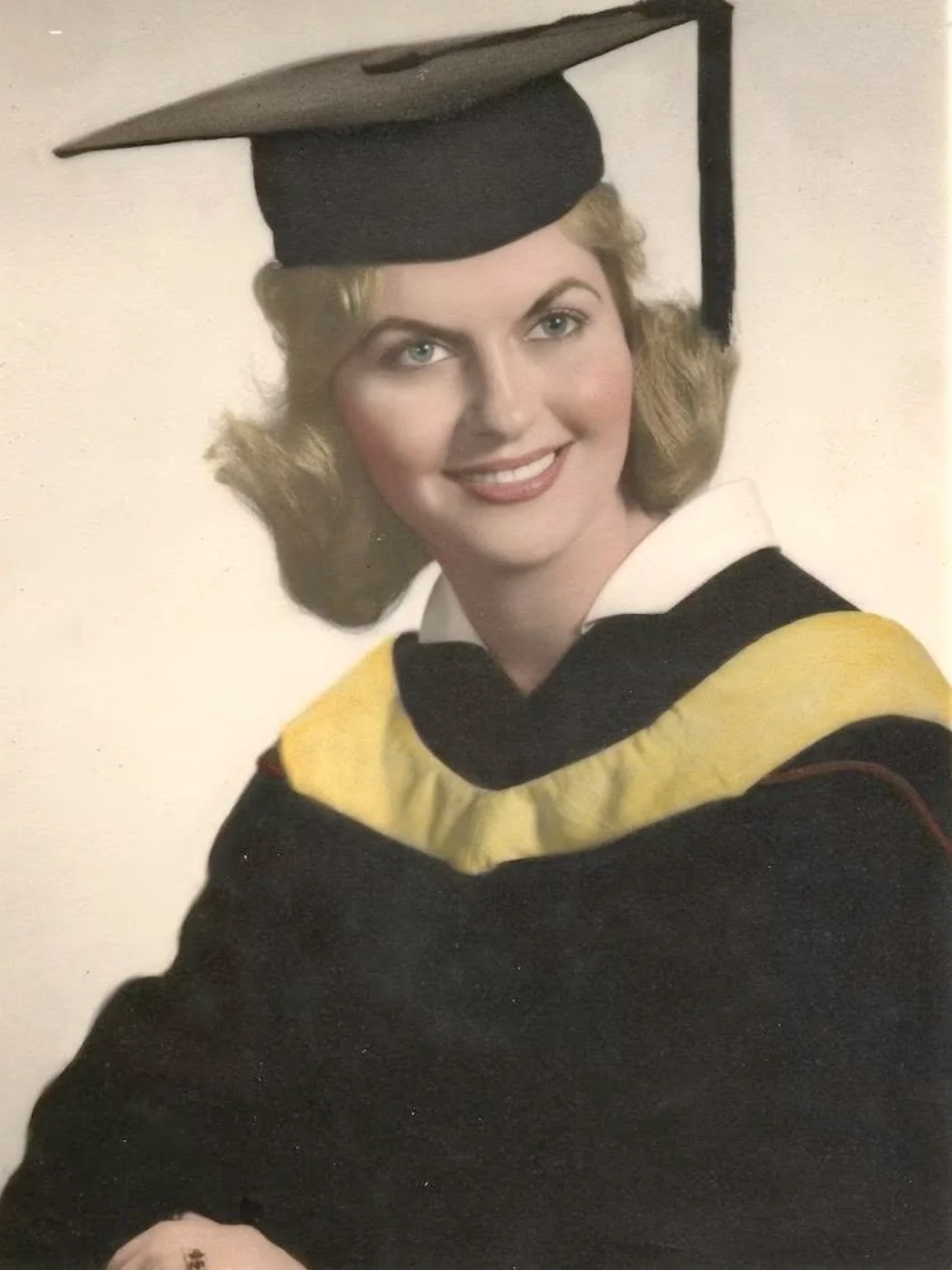
MaryAnne O’Donnell, one of three women to graduate St. Joseph’s University class of 1962.
Adapted from a keynote given at the FAWCO 2026 Region 5 Meeting in Cologne.
Until the age of 37, I was a professional pianist.
If you think about the image of a pianist, you might picture one person sitting alone at the "great black beast" - the nine-foot concert grand - in the middle of an enormous stage, expected to produce something extraordinary. Hundreds of people may be listening, but the pianist is, at least apparently, entirely on her own.
It's an image we've come to associate with achievement: one person who has somehow risen above ordinary limits through talent, discipline, and sheer stubbornness.
Anyone who has actually worked as a musician knows how misleading that image of the lone musical wolf is. So I want to begin with how many people it took to make me a musician. First of all, my mother.
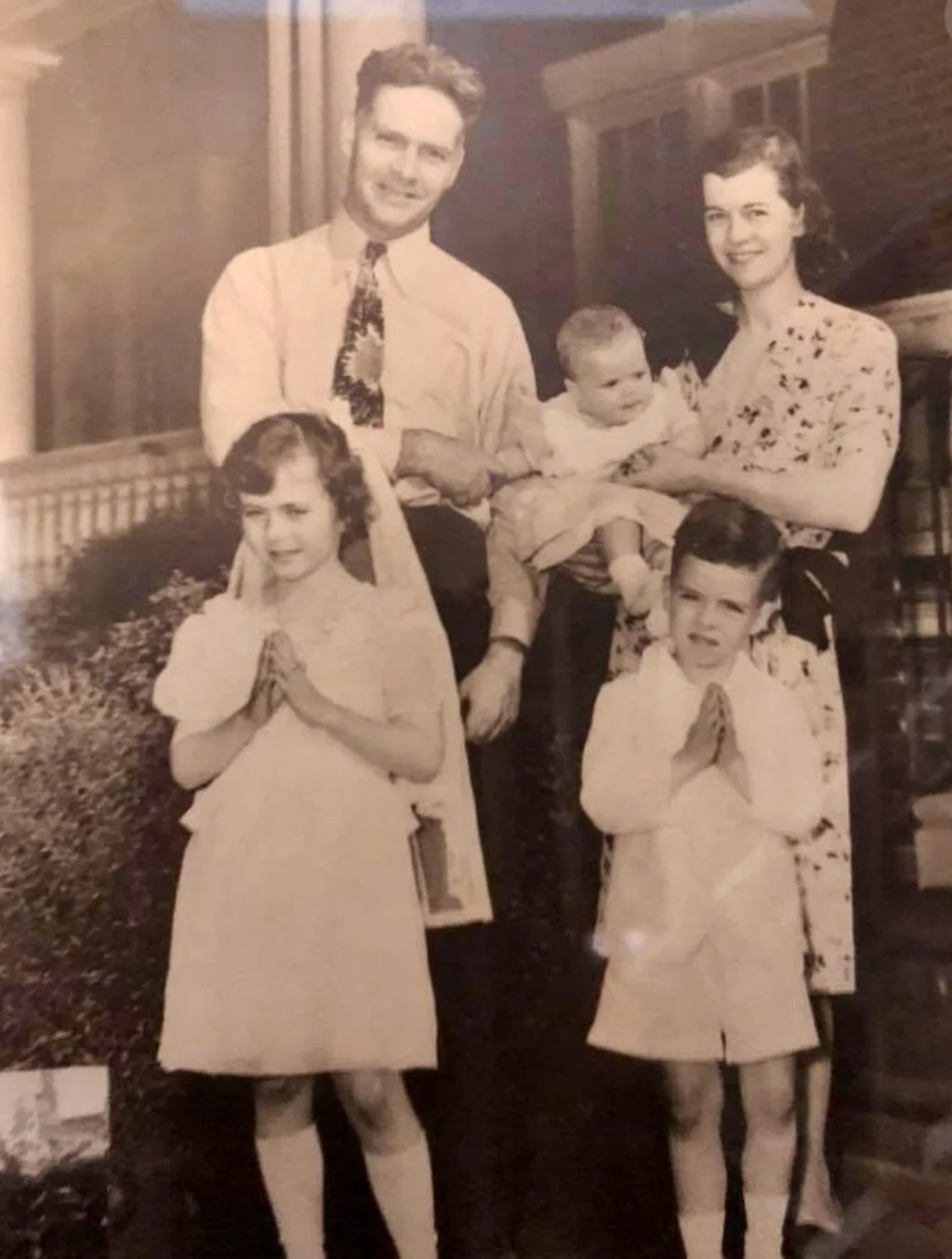
Easter Sunday, dressed in their finest. My mother is the oldest child.
My mother was a lioness. She grew up in the 1940s in poverty.
Her father suffered from debilitating alcoholism, and her mother supported a family of five on a waitress's wage of 38 dollars a week. The family became six when an uncle came home battered and rageful from the Second World War. Very early in life, my mother decided she was going to change the circumstances she had been born into. She started working at fifteen, and by twenty-one had saved 1,500 dollars, enough for a down payment on a beautiful Victorian home in Philadelphia. The rental apartments upstairs paid the mortgage, and she gave her parents and two younger siblings a chance at a life of stability. At the same time, she put herself through night school at St. Joseph’s University, one of three women in the first class to allow women. The other two were nuns.
She was a woman of enormous determination, considerable opinions, and very little inclination to be told what she could or couldn't do. I remember her once getting into a fierce argument in a New Jersey grocery store with another mom, a woman from Northern Ireland. My mother was quite sure she knew better than an actual Northern Irish woman what the Irish needed. Independence, she explained, was obviously preferable to being enslaved. She raised her voice in front of the meat counter. My mother was not someone who let an opportunity for a political argument pass her by, and it could get scary.
And this same woman, who had spent much of her life making things happen through sheer force of will, did something rather uncharacteristic when I began getting serious about the piano.
She sat quietly with me.
I was about four when a piano entered our house. My older brothers were away at school during the day, and I began picking out tunes by ear. I was probably a little lonely, and the piano was a fascinating world to explore.
For years, my mother would sit with me while I practiced. She didn’t tell me what to do, correct my mistakes, or give me the evil eye, which I knew well from other circumstances - for example, when she caught me roaming around New York City after my lessons. She didn’t knit or read. She didn’t sigh, or breathe loudly, or swear, which for my mother took some restraint. She just listened. She sat there because she didn’t want me to be lonely.
Learning an instrument requires extraordinary amounts of time alone. There are scales to learn, passages to repeat, movements to refine, and musical problems that sometimes take weeks or months to understand. Much of this work is solitary and, frankly, mind-numbingly repetitive.
My mother couldn't do the practicing for me. But her presence changed what that solitude felt like. Without ever teaching me anything about the piano, she showed me that the work could be mine alone without my having to be alone while doing it.
And then there were my teachers.
They opened entire worlds for me, and I owe them a lot. They introduced me to music I couldn't have imagined, took my ambitions seriously, and sometimes believed in me long before I did.
They also taught me some things they probably never meant to teach.
Once, when I was studying in Boston, I proudly told my teacher that I had practiced eleven hours that day.
"Why not twelve?" he replied.
Looking back, as a psychologist who often works with musicians struggling with injuries, perfectionism, and burnout, I would hope a teacher might respond differently to a braggadocious, wayward teenager. (Eleven hours, by the way, is completely unnecessary. A fraction of it would have made me a better musician.)
But he was an extraordinary teacher, and his generosity and artistic conviction helped me step closer to the musician I wanted to be. His confidence in me became part of my confidence in myself. The trouble was that I absorbed his expectations along with everything else he gave me. Working harder, alone, became my answer to almost any difficulty. I became very good at overriding fatigue, ignoring discomfort, and treating physical limits as obstacles to be conquered through ever more work. That part, if I'm honest, I may also have learned from my mother.
We carry other people around inside us, long after they have left the room. Their encouragement turns into our confidence, and sometimes their criticism turns into the voice we use on ourselves.
The same relationships that make us capable of extraordinary things can teach us to ignore our limits, and to confuse what we're worth with what we accomplish.
In my case, that became painfully apparent when the career I had spent most of my life building began to self-destruct.
For about fifteen years, I had lived with chronic pain, fingers that had lost their feeling, and a hand that didn't always do what I asked of it. I saw physiotherapists, specialists in rehabilitating injured pianists, psychotherapists. Some of it helped. None of it broke the cycle.
Somewhere in the middle of those difficult years, I was talking with a good friend about my difficulties. She looked down at my left hand, reached out and took hold of it, and said, quite shocked:
"It looks like the hand of a dead person."
Not, perhaps, what one hopes to hear from a friend.
I've never forgotten it.
I had been living with that hand every single day: protecting it, working around it, trying to persuade it to do what I needed it to do. Along the way, I had stopped seeing how serious things had become. It took someone who cared enough to look, and was honest enough to say what she saw, to make me confront something I had been trying very hard not to know.
She could see it because she was standing somewhere else.
Eventually, I stopped performing professionally. It was a dreadful thing to be a pianist in that condition, and stopping was both necessary and devastating.
Then came the question that anyone who has lost a role they've inhabited for a long time will recognize:
Who am I now?
Many musicians grow up with that identity woven into their very core. It's hard to pull the strands apart. Should I study something? What? What was I even interested in? My honest answer was usually: "I have no idea."
I eventually landed on psychology, at the Freie Universität in Berlin. Several of us were in our thirties and changing careers. We called ourselves the "old souls." We hired a nineteen-year-old redhead, sharp as a tack, to tutor us in statistics, each chipping in five euros, and she patiently repeated the incomprehensible until it made just enough sense to pass those goddamn exams.
I now call those my Muddled Years.
Even with the old souls, I often felt very alone. My career change coincided with my biological clock going off. My daughter was born in my second semester, and I often brought her along to seminars and lectures. I was a strange bird at that university: twice the age of most of the students, with a baby in tow.
There were plenty of people around me. But I had lost the community in which I had understood myself for most of my life, and I didn't yet know where I belonged.
I had spent most of my life learning how to become a musician. Nobody had taught me how to stop being one.
Years later, in my psychotherapeutic work with musicians, I came across versions of that experience over and over again. The crises were different, but the loneliness was similar. I began to wonder what it would look like to create a place where artists didn't have to keep signaling success in order to belong.
What I longed for was a perpetual green room.
In the theater, the green room is the room behind the stage. It's where performers prepare, catch their breath, get looked after, and fall apart a little if they need to, before and after they go out into the light.
The audience never sees it. No theater is really complete without it.
In October 2020, in Cologne, I opened a small nonprofit called The Green Room. I found a space, dragged in second-hand furniture, assembled a group of wonderful teachers, and began offering workshops, counseling, and opportunities for artists to meet.
For about a month, things looked good.
Then Germany entered its second pandemic lockdown.
The Green Room closed.
The rent, unfortunately, kept going.
Everything that wasn't considered systemrelevant, essential to the system, had to shut down. And of course, a refuge for struggling artists was not considered essential to the system. Every month, my savings were eaten up a little further, and there was nothing to do about it, because we couldn't open our doors.
When we finally did reopen, things had changed. The artists who had once been so curious were exhausted and burnt out. We offered workshops for free, and nobody came. Teachers would arrive to give beautifully prepared classes to one person. Sometimes to no one.
Some evenings, the silence in that room was hard to bear.
Here's the embarrassing part.
I was trying to create a place where other people could acknowledge their vulnerability, uncertainty, and exhaustion. And I was remarkably reluctant to acknowledge my own.
On the outside, I was still the founder with a plan. I kept organizing, writing grant applications (about thirty a year), inviting people, and trying to make things work. Underneath, I was frightened, discouraged, and increasingly unsure whether the whole undertaking had been a terrible mistake.
A dear friend of mine, the wonderful jazz pianist Richie Beirach, once described this state better than I ever could. Writing to me about the terrible news from Gaza and Ukraine, he said:
"Oh, on the outside I'm ok. It even looks like I'm in perfect control, I'm sure like you. But UNDERNEATH I AM A SEETHING MASS OF MURDER AND ABJECT DEPRESSION, ANGER, AND DEEP ABYSMAL SADNESS."
(The capitals are his.)
Richie was writing about the news, and the news has hardly become gentler since. Beneath all of it runs a loneliness so widespread that public-health officials now describe it as a health risk on the scale of smoking.
Most of us carry all of this around while answering emails, organizing everything, and making dinner. On the surface, we look composed. Underneath are Richie's capital letters.
Composure is something we usually manage alone, in order to present well in public. Calm is a very different thing. Calm is something we usually find with other people.
I see this all the time in my practice, particularly in women who are used to being the responsible person in the room. We become extraordinarily practiced at sensing what other people need, anticipating problems, and making sure things keep functioning. And often, without noticing when it happened, we begin to regard our own need for support as a personal failure.
We live in a culture that places enormous demands on women and then sells them increasingly expensive ways to cope. Exercise, rest, and mindfulness can be genuinely valuable. But a multi-trillion-dollar industry has been built on the idea that stress is a private, individual problem, to be solved with better habits and better products. The pressures are structural and systemic. The responsibility for coping with them lands on the individual woman, and then someone sends her an invoice.
If we are always the capable one, the organizer, the listener, the person who knows what to do, it can become very difficult to admit that we, too, might need someone to sit beside us.
Many of us are far better at giving than receiving.
I was still trying to figure out what to do with all of this in The Green Room when, in February 2022, Russia invaded Ukraine.
Within days, it was clear that thousands of people would be arriving in Germany, among them many artists. And there I was, in my little Green Room in Cologne, whose whole mission was to support artists in crisis, feeling rather like a fraud. We had almost no money, very few volunteers, and no emergency infrastructure whatsoever.
My first thought was not exactly visionary.
It was: Well, someone could sleep on our couch.
But I sent out a message anyway.
"We want to help. How can we help?"
Within the first day, more than forty artists responded.
I thought I had an idea of what they would need. We had counseling. We had workshops. We had mindfulness and movement classes. I'm a psychologist. I think a lot about trauma, anxiety, displacement, and the psychological consequences of war.
Not one person asked when the yoga class was. Nobody asked about my excellent psychological counseling either.
What nearly every message said, in one way or another, was: Is there work for me there? Can I still be an artist if I move to Germany?
"I'm a dancer. In my country war, situation is dangerous and I don't work. I miss my job very much and I'd like continue my creativity. If you can help me, it would be great."
"Hello! I am a musician from Kharkiv. Our house was under fire, so I must leave Ukraine. Now I am in Germany. Please let me know if you will have any work opportunities."
"I am going to border now from Ukraine to Slovakia. How situation in Germany with work? It's real that there is work for refugee?"
They wanted to perform, compose, create. They wanted to go on being the people they had spent their whole lives becoming, before those lives were violently disrupted.
This, I understood. I had lost my own professional identity once, and I remembered that reassurance hadn't helped much. Having something to do had.
So we changed direction. The Green Room began organizing concerts, performances, and paid artistic opportunities. People offered instruments, rehearsal spaces, rooms, transportation, contacts, and money. That year, we created paid work for more than seventy Ukrainian artists.
It was one of the most extraordinary experiences of my professional life.
We didn't create this project through a finely tuned proposal and a SWOT analysis of Strengths, Weaknesses, Opportunities, and Threats. We just jumped in, because we had to. It was scary.
But the artists themselves told us what they needed, and we listened and responded where we could. Musicians and cultural organizations offered opportunities. Volunteers, many of them from the American International Women's Club of Cologne, found practical solutions. Funders responded to our call. People who had never met began working together.
A network began to form.
Support begins with curiosity: asking questions to which we don't already know the answers, and taking the answers seriously. We often confuse independence with isolation. My mother sat beside me so that I could do something difficult myself. The Ukrainian artists wanted the chance to do their own work. In both cases, it was the support that made the independence possible.
We tend to remember the person who stood up, or refused to stand up. We remember the speech, the photograph, the defining moment. We know far less about the people who organized the meetings, made the phone calls, prepared the food, and held a community together long enough for change to become possible.
In September 2022, a 22-year-old Kurdish-Iranian woman named Jina Mahsa Amini died in the custody of Iran's so-called morality police, after being arrested for allegedly wearing her headscarf improperly. At her funeral in her hometown of Saqqez, women took off their headscarves and began to chant a Kurdish slogan: Jin, Jiyan, Azadî. Woman, Life, Freedom.
The movement spread across Iran and around the world. Many protesters were imprisoned, including women held in Tehran's Evin prison.
And inside those prison walls, women found ways of sustaining one another.
The Nobel Peace Prize laureate Narges Mohammadi has written about life in the women's ward: singing, dancing, cutting and styling one another's hair, wearing colorful clothes, and finding reasons to laugh. Another prisoner, Sepideh Gholian, baked cakes and pastries behind those walls and later wrote a cookbook: The Evin Prison Bakers' Club: Surviving Iran's Most Notorious Prisons in 16 Recipes.
These were, of course, not solutions to imprisonment or political repression. The women remained in danger, and their circumstances were profoundly unjust.
But they were ways of holding on to what the prison was designed to take away: their humanity, their relationships, their ability to act, however narrow the possibilities had become.
What those women built in the ward was more than a way of getting through. It was a form of resistance.
We remember the stage.
We forget the green room.
Women have been building networks like this for generations, often with very little formal authority or training and even less recognition.
But I want to be careful here.
I don't think women are necessarily better at caring for one another, or that we possess some special biological gift for cooperation. Women have often become extraordinarily skilled at sustaining relationships because they have been expected to. Sometimes that work has been freely chosen and deeply meaningful. Sometimes it has been demanded, taken for granted, or performed at considerable personal cost.
Often both at once.
And women are not always kind to one another. Anyone who survived middle school knows this.
Scarcity can turn potential allies into competitors, particularly when there's only one seat at the table. Women are no more immune than men to envy, exclusion, or the temptation to protect whatever power they've managed to acquire.
Community doesn't happen simply because we put people in a room together. It takes work, and sometimes it's hard work.
I learned that very quickly at The Green Room.
As our work expanded, we began hosting displaced and dissident artists from Ukraine, Russia, Iran, and elsewhere. Some had fled Russian aggression. Others were Russian dissidents who had themselves been forced to leave their country. Their losses were different, and their ideas of what solidarity required were not always compatible.
Many arrived carrying fresh, unprocessed trauma. Despite two degrees in psychology and years of therapeutic training, I was not prepared for how deep it went. There were threats.
At times, I felt completely out of my depth.
I had imagined a refuge as a peaceful place. It turns out a refuge is often where people finally let out the anger, grief, and fear they've been carrying, and that can be hard on everyone in the room.
And then there were the financial realities.
In 2023, one of our major funders pulled out without warning. Two artists at risk had already been invited and were preparing to travel. We had to disinvite one of them, a remarkably talented playwright from Turkey. It was one of the most painful decisions I've ever had to make.
Later, a major European proposal for thousands of hours of mental-health support for musicians scored well above the funding threshold and was then rejected anyway. One of the criticisms concerned our publicity plans.
We had tried to build a place for artists who weren't shining, and we were told we hadn't done enough to make ourselves shine. Which is difficult when what you offer is confidential.
And yet people kept showing up. Sometimes with money or expertise. Sometimes with a room, a contact, a meal, or an idea. Sometimes simply willing to listen while I tried to work out what to do next.
Not everyone stayed, and not every project succeeded. But enough people kept responding to one another that something continued to exist.
And along the way, I lost most of my shame about failing. When you've failed publicly often enough, there's very little point in pretending you have everything under control.
I've become, quite honestly, rather shameless about the failing part of my story.
And I've found that liberating.
Many of you have packed up a life and rebuilt it in another country, sometimes more than once. I've crossed the Atlantic to begin again five times myself.
Moving countries can be exhilarating. It also strips away much of the invisible structure of everyday life: the people who have known you for years, the references you don't have to explain, the language in which you can be effortlessly funny, irritated, or vulnerable. Highly competent women suddenly find themselves struggling to make a doctor's appointment or decipher a bureaucratic letter.
This is one of the reasons I so value organizations like FAWCO and its member clubs. They help rebuild some of what migration takes away. A woman who has lived in a country for twenty years helps someone who arrived twenty days ago. And eventually, the person who once needed help becomes the person who offers it.
But I hope these communities can be something more than networks of highly capable women helping one another manage very complicated lives.
I hope they can also be places where no one has to be endlessly capable, or overperform, or pretend she isn't struggling.
Which brings me back to my mother.
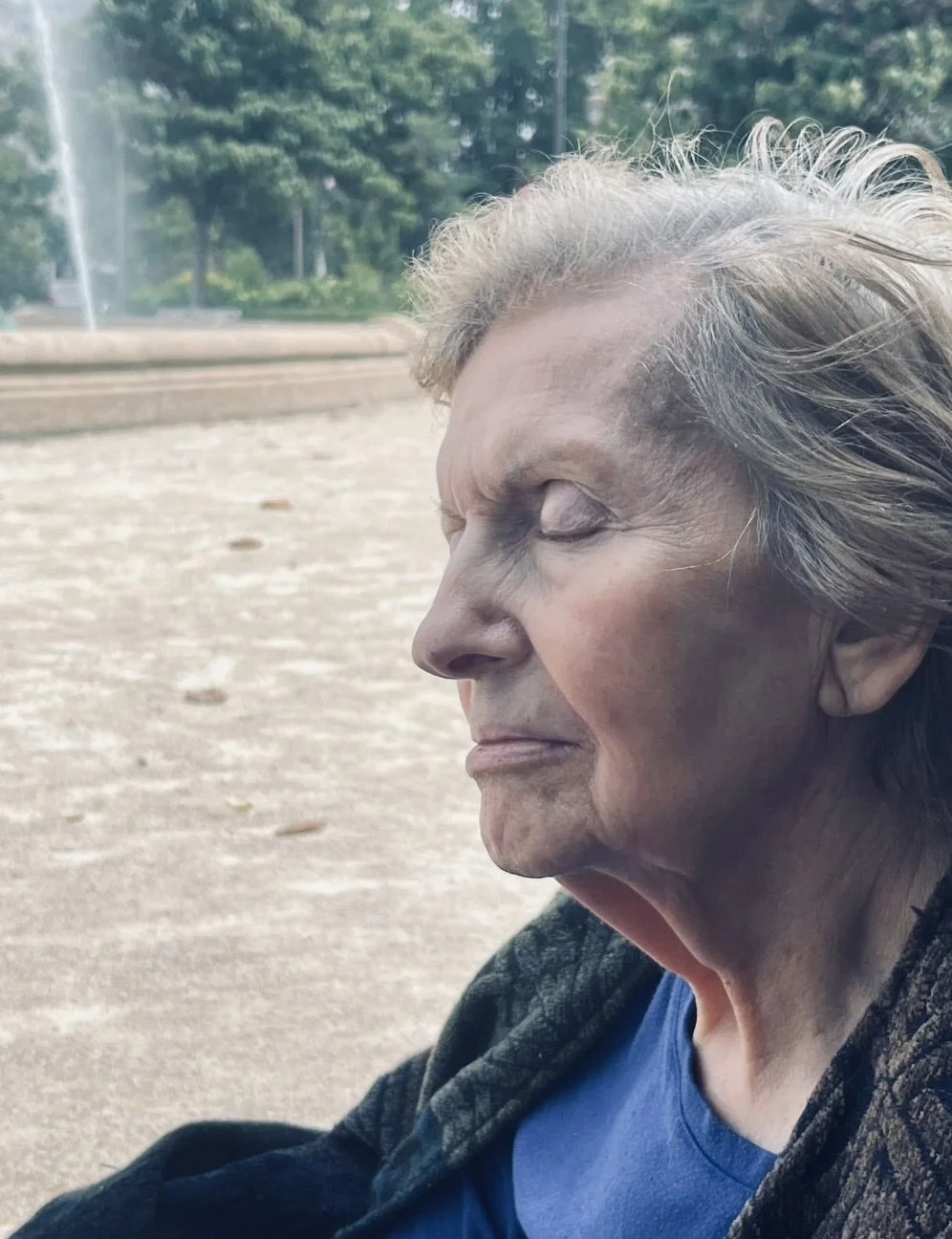
Mom in 2023
I began by describing her as a lioness, a woman who pulled her family out of poverty through determination and ingenuity. And she was. She still is.
But I've been thinking about her differently as I've written this.
For all her strength, she understood something that I would spend much of my adult life struggling to learn. She knew that sitting beside someone could be just as important as urging them to work harder.
She never asked me to perform for her when she sat beside the piano. She didn't correct my mistakes or measure my progress. She simply kept me company.
And I wonder now how often she had the chance to experience that herself. How often did someone sit quietly beside her, without expecting her to solve a problem, make a decision, or take responsibility for somebody else?
I don't know.
And I can’t ask her now. My mother is in the late stages of Lewy body dementia, which has taken away her ability to speak.
It has not taken away the evil eye.
These days, when I visit, I sit beside her. I don’t ask anything of her. I just keep her company. Sometimes I sing Christmas Carols to her, even when it’s not Christmas.
We admire strong women, and with good reason. Perhaps we should be a little more curious about why they have to be strong, what their strength costs them, and whether they have somewhere they can put it down.
My mother taught me many things, including some I've had to unlearn. But one of the most valuable lessons she gave me was that being capable of doing something alone doesn't mean we should have to.
And with everything we are living through in the world today, I want to leave you with this thought:
We are not meant to do this alone.